
Tailoring UFGS specifications,
powered by AI.
From master files to project-ready specs in
hours[days][weeks][months].
Built by engineers, for spec professionals.
Created from
project documents, design criteria, and RFPs [guesswork][copy-paste],
approved by
the engineer[_______].
Why this matters
UFGS tailoring is slow.
Hundreds of master sections. Dozens matter to your project, each full of brackets, fill-ins, and paragraphs that may not apply.
Today, someone has to
- 1.1Select sections from hundreds of master files
- 1.2Remove non-applicable requirements
- 1.3Resolve brackets and fill-ins
- 1.4Reconcile references and submittals
- 1.5Cross-reference host-nation standards on OCONUS work
- 1.6Verify every project requirement is covered
- 1.7Preserve SpecsIntact compatibility
- 1.8Document why each decision was made
With SpecStage
- AI makes the first pass: brackets, fill-ins, paragraphs, table rows, references, host-nation standards
- You review decisions, not documents: accept, override, or defer, with the rationale beside each
- A coverage audit flags what the spec still doesn't say
- Every choice is recorded, exportable, and approved by you
That's the difference between formatting a spec and engineering one.
What it does
A streamlined workflow from documents to delivery.
Set up a project on a pinned UFGS library and drop in your documents.
SpecStage takes it from there; you review everything in the spec.
Automated section recommendation
Reads your documents and recommends the right UFGS sections. You confirm before tailoring begins.
Project-aware tailoring
Brackets, fill-ins, paragraphs, table rows, and host-nation standards, resolved against your project.
A complete export suite
SpecsIntact files, project PDFs, Submittal Register, audit log, and a portable bundle.
Built for the work
By engineers who've actually done this.
We've chased brackets, hunted fill-ins, cross-referenced host-nation standards by hand, and packaged SpecsIntact deliveries under deadline. SpecStage makes every one of those steps faster, and entirely auditable.
- Built around UFGS and SpecsIntact workflows
- Designed for USACE, NAVFAC, and AFCEC project delivery
- Engineer review, traceability, and export control at every stage
Engineer-controlled by design
SpecStage proposes.
You decide.
Every output is reviewable, traceable, and aligned to your project's requirements.
2.4.1 Aluminum Sheet Panels
2.4.2 Steel Sheet Panels
Roll-form steel sheet roof panels to the specified profile, [26][24][22][20][18] gauge.
[Galvanized] [Aluminum-Zinc alloy coated] steel sheet conforming to ASTM A792/A792M.
Try it: click a bracketed option to make the call yourself.
The review surface
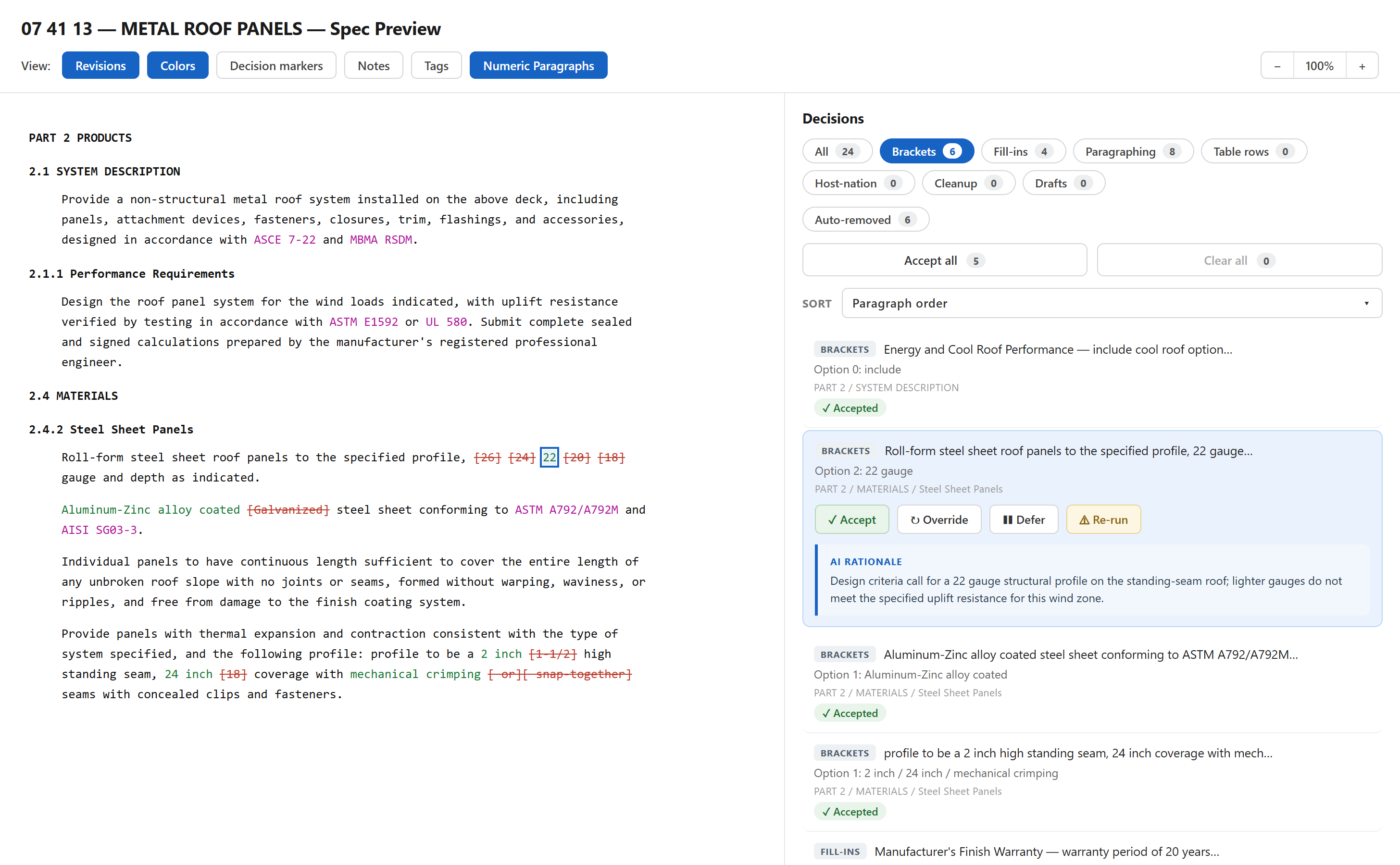
Review every decision where it lands: in the spec.
Sections render in a SpecsIntact-style view with revision marks. Each decision is anchored to the text it affects, and your call flows straight into the deliverable.
Coverage Audit
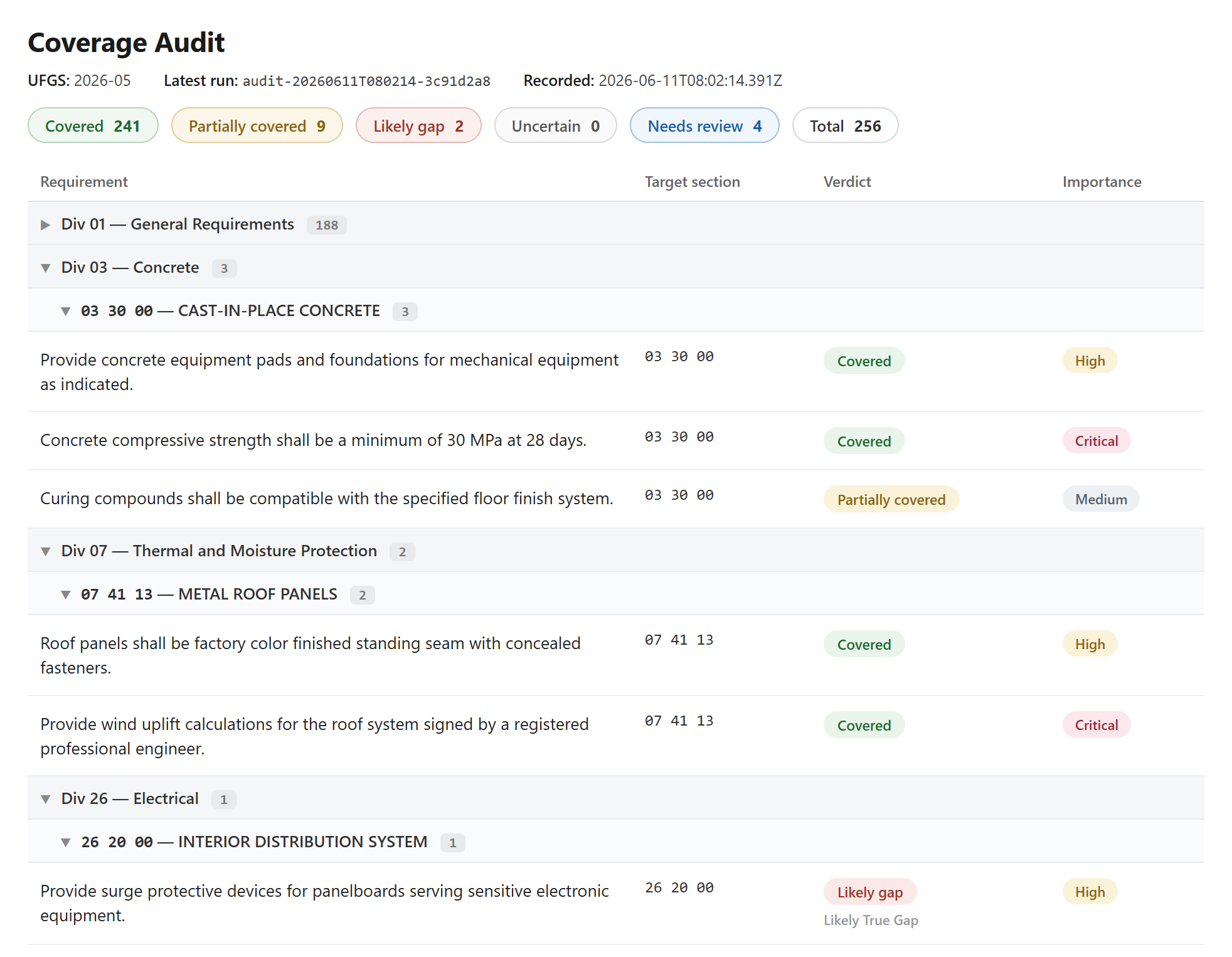
Catch what the spec never says.
SpecStage extracts the requirements in your documents, with source quotes, and checks them against the tailored spec. A spec can pass validation and still be missing something. This is the check that finds it.
- Evidence-backed verdicts: covered, partially covered, likely gap
- You disposition every finding; nothing closes without your call
- AI-drafted language for confirmed gaps, placed in the spec for review
- The full register exports to Excel
Ask the Library
Hundreds of master sections.
One question away.
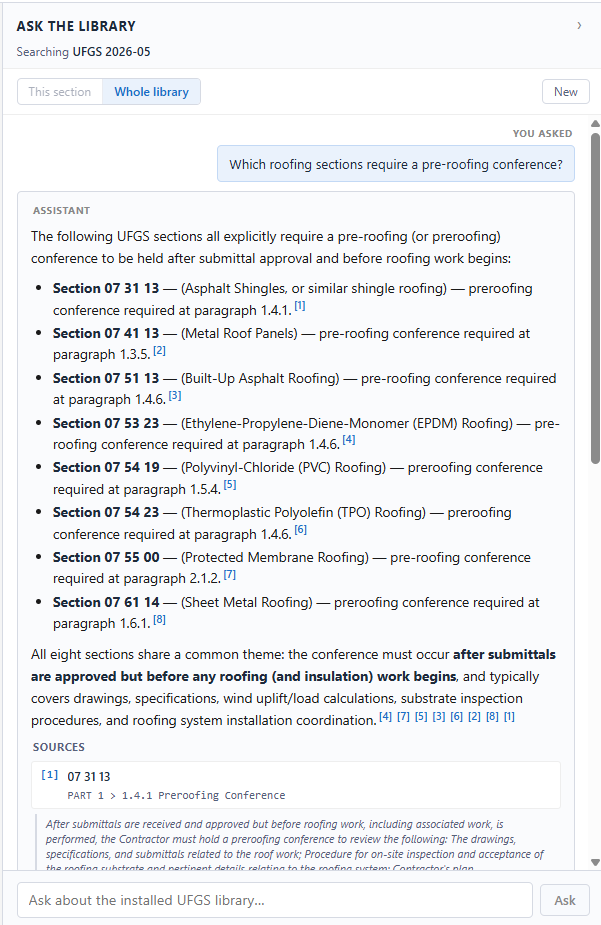
Ask the installed UFGS library a question in plain language. Answers cite the exact paragraphs they came from, with the source passages quoted underneath.
- Searches the whole library, or just the section you're reading
- Citations are validated against the master text, never invented
- On hand throughout tailoring, review, and the coverage audit
Your data
It stays on your desktop.
A real desktop app
SpecStage is a desktop application. Project files, UFGS masters, exports, and decision logs remain on your machine. There is no cloud workspace to upload into.
No document storage
For AI-assisted analysis, SpecStage sends only the minimum required excerpts and project context through a secured inference service to the AI model provider. SpecStage does not store project documents or tailored outputs on its servers.
Your job folder, your format
Output lands on your disk as SpecsIntact-compatible files, PDFs, and Excel, straight into the workflow you already run.
Full details in the privacy policy.
Currently in private beta.
We're accepting a small number of federal construction engineers and specification professionals. Email us if you'd like to be considered.
Request access hello@specstage.com · we'll only email you about SpecStage